

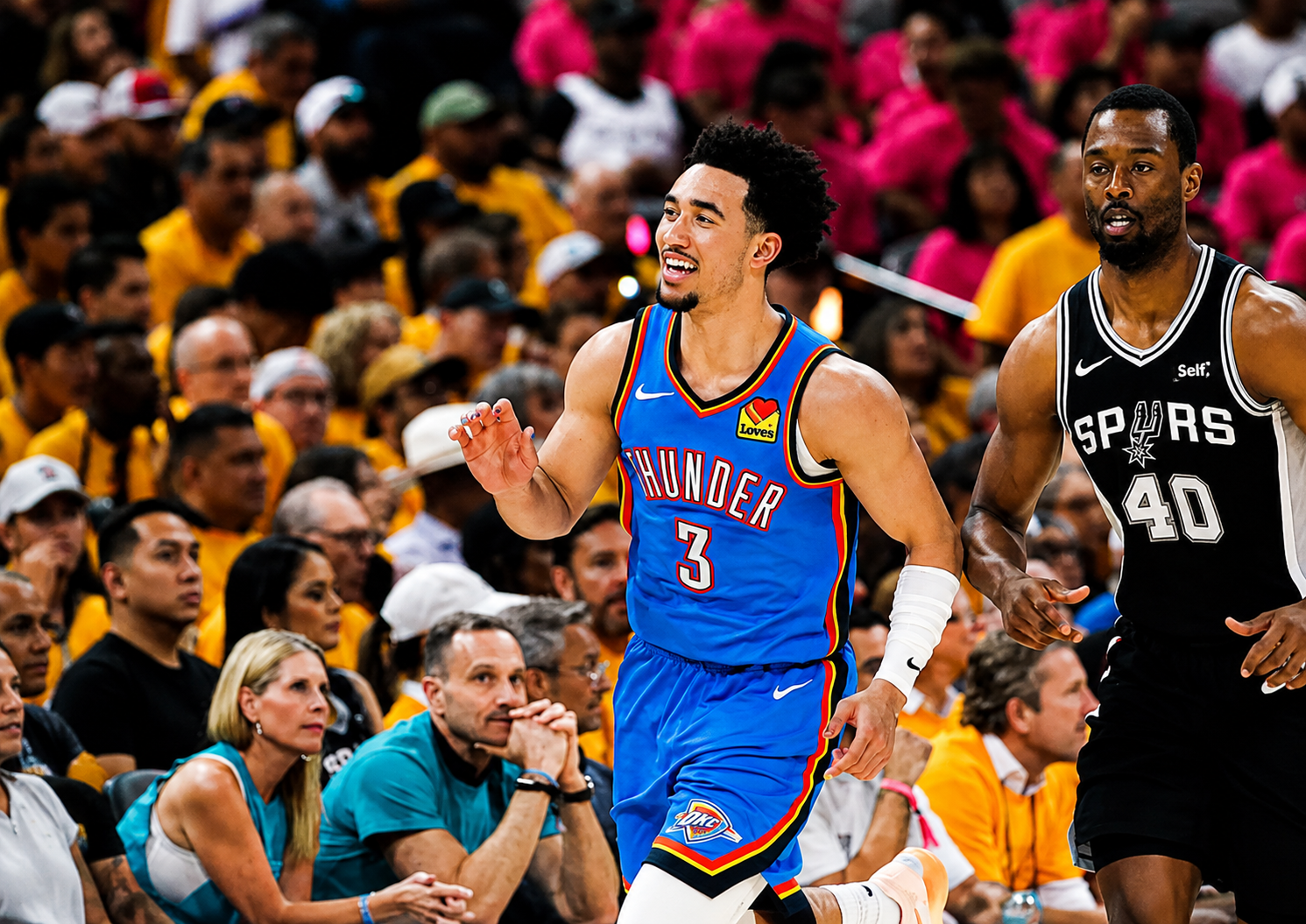
The Western Conference Finals have already turned into a much clearer matchup than the usual Shai Gilgeous-Alexander vs. Victor Wembanyama framing.
Through three games, Oklahoma City has controlled the series with depth, not just star power, and that has left San Antonio trying to survive with a much shorter rotation while dealing with De’Aaron Fox’s ankle issue and other lineup uncertainty.
The Thunder won Game 3, 123-108, to take a 2-1 series lead, and their bench alone scored 76 points, the most in any conference finals game since the NBA began tracking that type of stat in the modern era.
That is the real story of the series so far. Oklahoma City has been able to keep rolling fresh bodies onto the floor, while San Antonio has had to tighten everything around its starters and ride a short group for heavy minutes.
The Thunder’s bench has now produced 183 points through the first three games of the series, while the Spurs have had to deal with Fox missing Game 1, sitting out Game 2 with a right high ankle sprain, and then returning for Game 3 before the latest Game 4 injury report listed him as available.
That kind of lineup instability has a direct effect on how many players a coach can trust, and it is the main reason this series has tilted toward Oklahoma City.
Why the rotation gap is deciding the series
San Antonio has tried to keep pace with Wembanyama carrying the offense and the defense, but Oklahoma City keeps finding answers elsewhere.
In Game 3, Wembanyama led the Spurs with 26 points, yet the Thunder still pulled away because their bench kept winning every pocket of the game.
The local Game 3 breakdown described Oklahoma City’s bench scoring margin as a 53-point advantage, and that is the kind of number that explains why a series can tilt even when the headline star is still producing.
That is where the tactical imbalance shows up. The Thunder can lean on multiple second-unit pieces, while the Spurs have had to piece together minutes around injuries and still figure out which combinations can survive Oklahoma City’s pace and pressure.
The NBA’s preview before the series already flagged depth as one of the key themes, and Game 3 showed exactly why. Oklahoma City does not need one bench player to carry the load every night; it can rotate waves of contributors and keep the pressure on.
Game 4 now carries the weight
The next swing game is Game 4 on Sunday at 7 p.m., and San Antonio’s latest injury report is at least a small relief.
Fox and Dylan Harper are expected to be available, and that matters because the Spurs need more ball-handling and more creation just to keep their rotation functional against a deep Thunder group.
Game 3 showed that San Antonio can compete for stretches, but the series has also made clear that it cannot afford long dry spells from the bench or another night where Oklahoma City’s second unit overwhelms the floor.
If the Spurs are going to change the tone, it probably starts there. They need Fox healthy enough to steady the offense, Wembanyama to keep forcing Oklahoma City into adjustments, and at least a few role players to win their minutes instead of merely surviving them.
Otherwise, the Thunder’s depth will keep doing the same thing it has done through three games: turning a close matchup on paper into a series where the better and deeper group keeps pulling away.
