

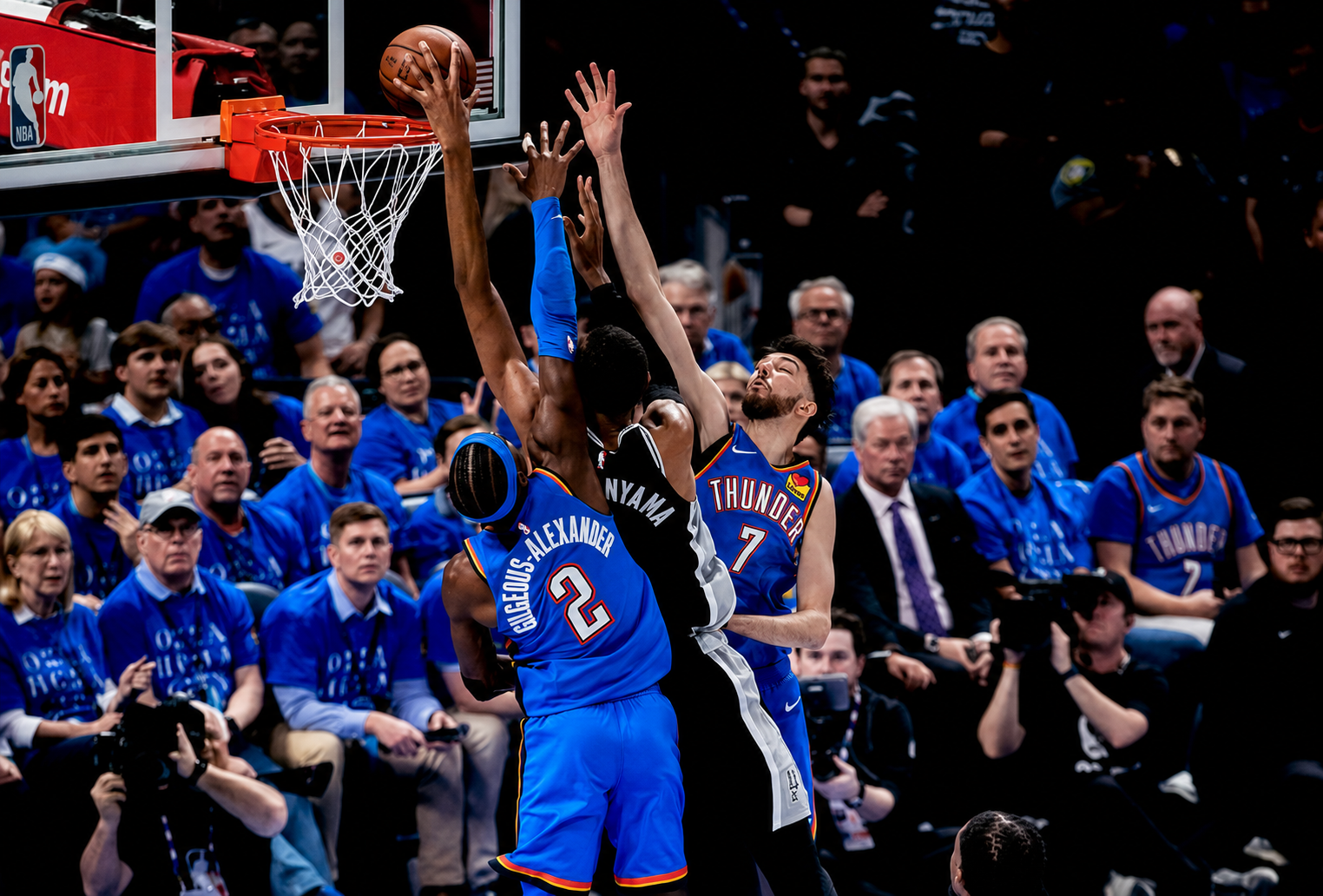
Before Monday night’s tip-off at the Paycom Center, the NBA handed Shai Gilgeous-Alexander his second consecutive Most Valuable Player award. He accepted it on the court in front of his home crowd, the ceremony running in the final minutes before the biggest game of the season.
Then Victor Wembanyama went out and put up 41 points and 24 rebounds in 49 minutes of double overtime basketball and the San Antonio Spurs walked out of Oklahoma City with a 1-0 series lead.
The moment felt like a statement. It was also, in a way that nobody is quite writing about yet, a echo.
Twelve years ago, in the spring of 2014, the San Antonio Spurs and the Oklahoma City Thunder met in the Western Conference Finals. San Antonio won that series 4-2, with a 38-year-old Tim Duncan anchoring a dynasty in its final championship season.
The Spurs went on to beat the Miami Heat in the Finals. It was the last title of the Gregg Popovich era, the last chapter of one of the most decorated runs any franchise has produced in the modern era of the sport.
Now the same two franchises are here again. Same round. Same stage. A different world entirely.
The Last Time These Teams Were Here
The 2014 Western Conference Finals was supposed to be the end of San Antonio’s window.
Tim Duncan was already 38, playing through the kind of minutes load that would have finished most big men years earlier. Tony Parker and Manu Ginobili were aging.
The Thunder, led by reigning MVP Kevin Durant and an explosive Russell Westbrook, looked like the future.
Oklahoma City had beaten the Spurs in the 2012 Conference Finals after San Antonio went up 2-0 and then lost four straight. This felt like the window closing on one era and opening on another.
San Antonio handled Oklahoma City in Game 1 by 122-105, with Duncan scoring 27 points and controlling the paint from the opening tip.
Star power forward Serge Ibaka missed the first two games with a calf injury. The Spurs blew Oklahoma City out by 35 in Game 2.
The series looked finished before it started. OKC clawed back, winning Games 3 and 4, with Westbrook putting up 40 points and 10 assists in a dominant Game 4 performance and Ibaka returning to remind the league what he meant to that team’s defensive structure. The Thunder had the Spurs on the ropes.
San Antonio steadied. Duncan put up 22 points and 12 rebounds in a blowout Game 5. The Spurs closed the series in Game 6 in overtime, 112-107, and moved on to destroy the Miami Heat in the Finals with a performance so complete it essentially ended the LeBron-Wade-Bosh era in one five-game demolition.
Kawhi Leonard, then 22 years old, was named Finals MVP and the conversation around what the Spurs had built shifted from the old guard to the young player who had quietly grown into something special while the world was paying attention to Duncan.
Manu Ginobili played in that series.
He just reacted to Monday night’s result on X. “What a game! These two teams are incredible! 1-0 Spurs! This kid is really otherworldly!” He added an alien emoji.
For a man who played alongside Tim Duncan for over a decade, the alien comparison for Wembanyama felt right.
Gregg Popovich coached that 2014 championship team. He is not on the bench in 2026. He suffered a mild stroke in November 2024, five games into the season, stepped away from coaching in May 2025 after 29 seasons, and transitioned into a front office role.
The man in the chair now is Mitch Johnson, Popovich’s former assistant, carrying the culture of a franchise that has never really stopped building regardless of the names that have come and gone.
The Same Stage, A Completely Different Kind of Star
The parallel that is worth sitting with is not just that the same two franchises are here. It is the age at the center of it.
Kawhi Leonard was 22 years old during the 2014 Western Conference Finals. He was not yet the focal point of the series in the way he would become in the Finals against Miami.
But the seeds of what he was becoming were visible to anyone paying attention. He was long and physical and extraordinarily difficult to deal with on both ends.
He had not yet become the player who would carry championship teams in Toronto and Los Angeles, but the foundation was laid right there in 2014, in that same round, against some of those same Thunder players who are now front office executives and analysts.
Victor Wembanyama is 22 years old in 2026. The comparison ends there because Wembanyama is not what Kawhi was at 22.
He is not what anyone has been at 22. On Monday night he became the youngest player in NBA history to record 40 points and 20 rebounds in a playoff game.
He is the first player since Wilt Chamberlain in 1960 to log a 40-and-20 game in a conference finals debut. He hit a three-pointer from near the half-court logo late in the first overtime period, with his team down three, to tie the game and send it to a second extra session.
He played 49 minutes, then stood at the podium and talked about sheer willpower as if the preceding three hours had been a routine evening.
“We are ready to go in any environment, in any place, against anybody,” he said. “And even though we’ve still got a lot to learn, our effort should be over anybody else’s.”
This is the third time these franchises have met in the Western Conference Finals. The Thunder beat the Spurs in 2012, coming back from 2-0 down to win four straight in a series that haunted San Antonio until they returned and reversed it in 2014.
Now it is 2026, and the Spurs are starting a series the same way they did in that championship run, going on the road and winning Game 1. San Antonio won five of six regular season meetings with Oklahoma City this year.
The Thunder came in as the No. 1 seed, the defending conference champions, and the favorites by most measures.
The subplot that made Monday night even more layered was the ceremony before tip-off. Shai Gilgeous-Alexander accepted his second consecutive MVP award on the court in Oklahoma City, becoming only the 14th player in league history to win back-to-back MVP honors.
He joined a list that includes Jordan, LeBron, Magic, Moses Malone and Wembanyama’s own obvious historical comparisons.
Then his team fell behind, clawed back, built a lead in overtime, and watched Wembanyama hit a shot from near half court to take it away from them.
Coach Johnson said without hesitation that watching his star player observe that trophy presentation before the game was not irrelevant to what followed.
“One hundred percent,” Johnson said when asked if Wembanyama drew motivation from the moment. “He’s competitive. If you’re a competitor and you see another competitor get rewarded with what you want, that’s motivation.”
De’Aaron Fox missed the game with an ankle sprain. Dylan Harper, the 20-year-old rookie, started in his place and scored 24 points, grabbed 11 rebounds, dished 6 assists and forced 7 steals in his first career playoff start.
He hit the shot that forced the second overtime. He scored 9 of the Spurs’ 14 points in the second overtime period. He is 20 years old. He was not alive the last time these franchises played each other in this round.
In 2014 the Spurs had Tim Duncan at 38, willing his body through one final championship run on reputation and positioning and an unmatched understanding of how the game worked.
They won with experience and system and the accumulated wisdom of a dynasty. In 2026, they are winning because a 22-year-old alien is doing things in the conference finals that nobody has done since 1960, with a 20-year-old rookie making shots from the corner that seal double overtime wins.
The stage is the same. The franchises are the same. The rest of it is an entirely different sport. Game 2 is Wednesday night. Fox is expected back.
