

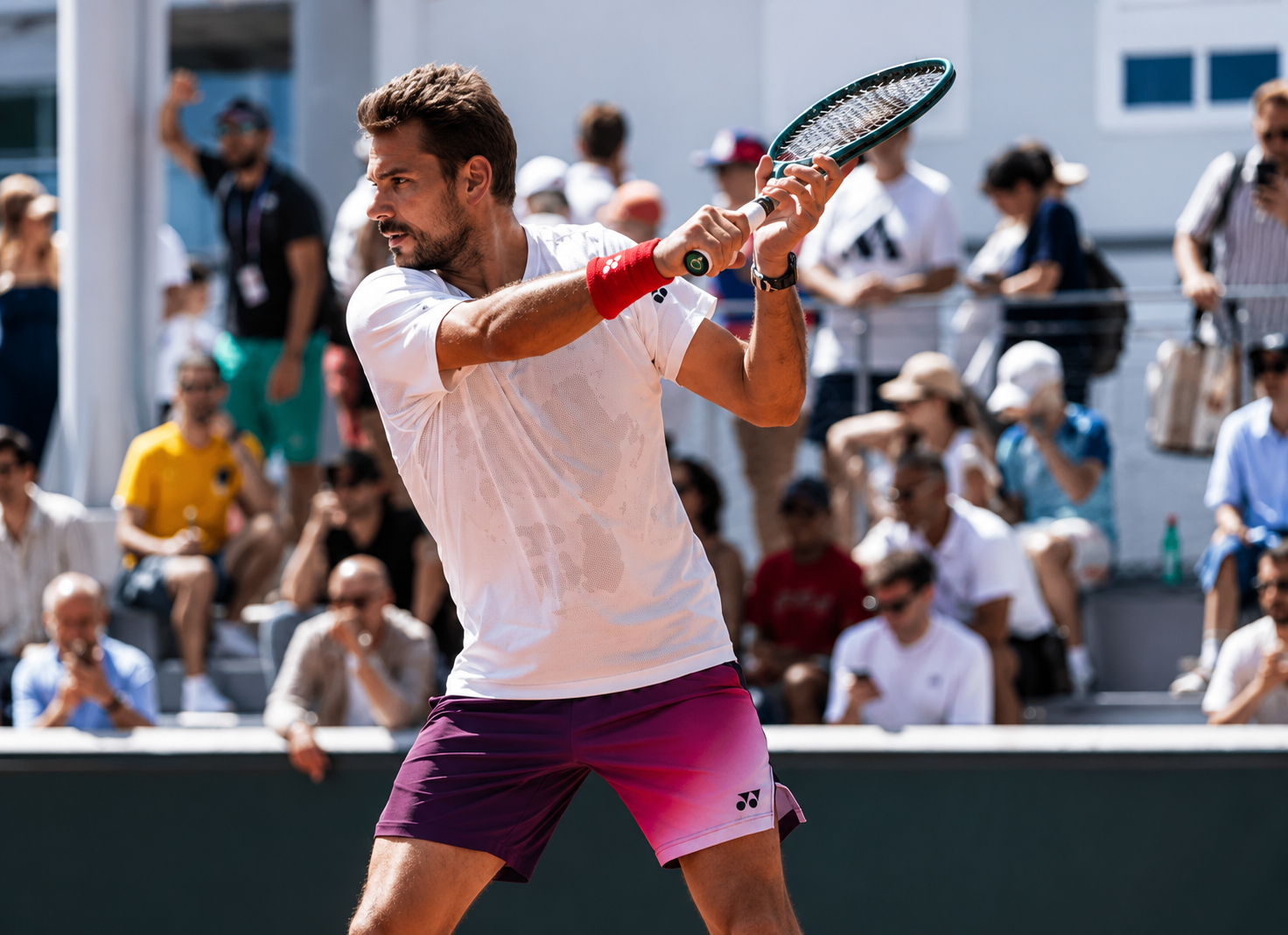
There is a stat buried inside the career of Stan Wawrinka that does not receive anything close to the attention it deserves, and the reason it does not is precisely because of who he spent his professional life standing next to.
When you share an era with Roger Federer, Rafael Nadal and Novak Djokovic, the three greatest players the sport has ever produced, you become a footnote in someone else’s story almost by default.
You win three Grand Slams and people still describe your career as a supporting role. You beat the world number one in a final and people remember the loser more than the winner.
What nobody can take from Wawrinka, and what makes his farewell to Roland-Garros this week carry a weight that a standard retirement cannot fully explain, is that he did it not once but three times.
He walked onto the biggest stages in tennis when the best player in the world was on the other side of the net and found a way to win.
He did it at the Australian Open in 2014 against Rafael Nadal, he did it at Roland-Garros in 2015 against Novak Djokovic, and he did it at the US Open in 2016 against Djokovic again.
Three Grand Slam finals. Three occasions where the world number one was waiting for him. Three wins. No other player in the history of the sport has done that.
He is walking into his 21st and final Roland-Garros appearance this week ranked 119th in the world, playing on a main-draw wildcard granted to him as a former champion, and his scheduled first-round opponent Arthur Fils has withdrawn with injury, meaning Wawrinka will instead begin his farewell against Dutch lucky loser Jesper de Jong, ranked 109th.
The draw handed him the most emotionally loaded match imaginable and then rearranged it at the last moment. Even the ending refuses to follow a script.
That is probably appropriate for a career as stubbornly unconventional as this one.
Three Grand Slams and Three Times the World Number One Was on the Other Side
To appreciate what Wawrinka actually did across those three finals, you have to remember what the world of tennis looked like in each of those years and why every neutral assumed he would lose before the match began.
In January 2014, the Australian Open had become something close to Novak Djokovic’s personal property. He had won it the previous three years in a row and owned Melbourne Park in a way that made the tournament feel like a formality each January.
But it was Rafael Nadal who stood across the net from Wawrinka in that final, having won the tournament himself the year before and having come into Melbourne as the world number one on a run of form that made him the clear favourite.
Wawrinka had beaten Djokovic in a five-set fourth-round match that produced some of the best tennis of that entire era, and then he simply continued.
He beat Nadal 6-3, 6-2, 3-6, 6-3 to win his first Grand Slam title at the age of 28, becoming only the second man outside the Big Four to win a major since the 2003 US Open. The reaction was something close to disbelief from the entire tennis world.
Then came Paris in 2015, which remains the high point and the defining image of everything Wawrinka achieved. Djokovic was at a stage of his career where he appeared genuinely unbeatable.
He had been trying to win Roland-Garros for years, had reached the final twice before and lost, and the 2015 version of the Serbian appeared to be the one that would finally conquer the clay in Paris.
He arrived for the final having not been taken to five sets all tournament. Wawrinka was wearing what would become his most famous outfit, a black and white patterned pair of shorts that the tennis world immediately identified as the single most divisive garment anyone had brought to a Grand Slam.
He won the match 4-6, 6-4, 6-3, 6-4 and in doing so produced what many who were watching ranked among the greatest single-match performances in the history of the sport, with a one-handed backhand that did things to clay-court tennis that only a specific type of player can produce. After the final he was asked about the shorts.
“I quite like them,” he said. “Apparently I’m the only one. They will be in the museum of Roland-Garros. You will see my shorts every day if you want.”
He wore the same shorts a year later at the 2016 US Open and beat Djokovic again in the final, this time 6-7(1), 6-4, 7-5, 6-3, to complete the collection of three major titles.
Djokovic was still world number one, still the best player on the planet, still the favourite when the match began.
Wawrinka’s record in Grand Slam finals against world number ones was at that point three played, three won. No one in the history of tennis has matched it.
For the record, he also defeated Federer in the quarterfinals of that 2015 Roland-Garros before beating Djokovic in the final.
On the same day, in the same tournament, he beat his compatriot and one of the greatest players ever to hold a racket, and then a week later beat the other one for the title. Two legends. One fortnight. One set of black and white shorts.
What a Final Roland-Garros Looks Like at Forty-One
The man walking onto the courts at Roland-Garros this week is not that version of Wawrinka, and nobody expects him to be. He is 41 years old, has been playing his farewell season under the banner of “One Last Push”, the phrase he posted on social media in December 2025 when he announced 2026 would be his final year on tour.
The announcement carried the kind of clarity that only comes from someone who has made peace with an ending.
“Every book needs an ending,” he wrote. “It’s time to write the final chapter of my career as a professional tennis player.”
The chapter has been difficult to read at times. He has won just six of his sixteen ATP matches this season, has needed wildcards to enter the biggest tournaments because his ranking no longer grants him direct acceptance, and has been eliminated in the first round of three of his past four Grand Slam appearances.
His last title on tour came in May 2017 at the Geneva Open, nearly nine years ago, before two left knee surgeries derailed everything and cost him what should have been his prime late-career years.
The physical gifts that made his backhand so devastating were always attached to a body that made him pay for the demands he put on it, and the bill eventually became too large to ignore.
His final tournament in his home country of Switzerland came last week at the Geneva Open, where he lost in the second round to Alex Michelsen in two tight tiebreak sets that showed flashes of the old game underneath the physical limitations.
He spent an emotional week in Switzerland saying goodbye to home soil before flying to Paris, and the French crowd, which has always adored him for how he plays and how he carries himself, is expected to give him a reception that makes what he is doing feel exactly as significant as it is.
The opponent he will actually face in the first round, Jesper de Jong, is a 25-year-old Dutch player currently ranked 109th in the world, a lucky loser who entered the draw when Fils withdrew.
It is not the farewell match that the draw initially promised. Fils, who has been dealing with the after-effects of the stress fracture he suffered at this tournament twelve months ago, joins a long list of absentees that includes Carlos Alcaraz, Lorenzo Musetti, Jack Draper and Holger Rune, meaning Roland-Garros 2026 is already missing significant pieces of the field before a ball has been struck.
The broader story of this tournament involves Jannik Sinner, currently on a 29-match winning streak and trying to become only the second man to complete the career Grand Slam at Roland-Garros itself, with Djokovic chasing a 25th major title on the other side of the draw.
Those are the narratives that will dominate the coverage across the fortnight and they deserve to.
But somewhere in the first day of first-round matches, in whatever court the draw assigns him, Wawrinka will walk out at Roland-Garros one last time, and the French crowd that watched him pull off one of the greatest upsets in the history of the tournament eleven years ago will be there to see it.
He is the only player in tennis history to beat the world number one in three different Grand Slam finals.
He spent his entire career being described as the fourth-best player in an era when there were only three stories worth telling, and he responded by writing his own story in the biggest moments available to him.
The shorts that produced it all will end up in the Roland-Garros museum, exactly as he promised they would.
He never quite got the recognition the record deserved while he was accumulating it. It would be fitting if the farewell tour finally gave him that, even if it comes eleven years too late.
