

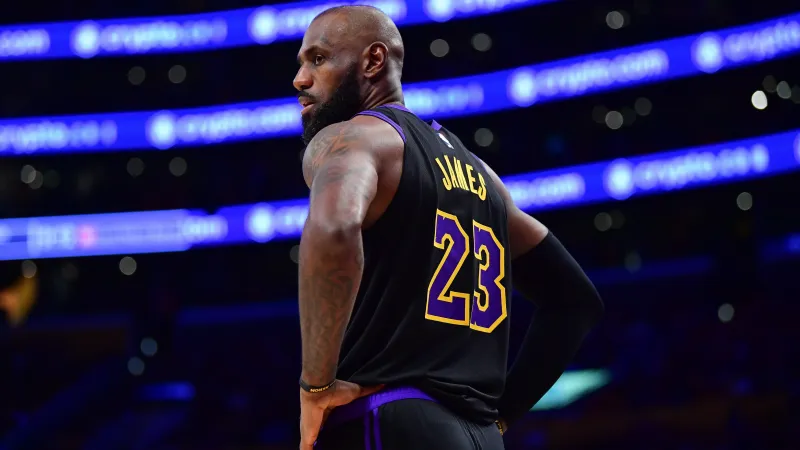
When the Oklahoma City Thunder finished off the Los Angeles Lakers in the Western Conference Semifinals last week, LeBron James walked off the floor at Crypto.com Arena and told reporters he had no idea what his future looked like.
“I don’t know, obviously. We’re still fresh from losing,” he said. “I’ll go back and recalibrate with my family and talk to them, and when the time comes, you guys will know what I decide to do.”
That was honest, and it was careful, and it was exactly the kind of answer you give when you know the real conversation is about to start in private.
What that private conversation is actually about is this. LeBron James is 41 years old, an unrestricted free agent for the first time since 2018, and the Los Angeles Lakers want to keep him.
The problem, per Marc Stein, is that they want to keep him at a “much lower number” than the $52,627,153 he made this season.
Stein called the scenario “thorny” and moved on. The word thorny is doing a lot of work in that sentence, because what the Lakers are asking for is something LeBron James has simply never agreed to in 23 years as a professional basketball player.
He has never in his career taken a meaningful pay cut. Not for loyalty, not for rings, not for any reason.
And now, in what may be the final contract negotiation of the greatest career in NBA history, his own franchise is the one asking him to start.
A Career Built Around Leverage, Not Discounts
LeBron entered the NBA in 2003 as the first overall pick by the Cleveland Cavaliers, selected straight out of St. Vincent-St. Mary High School in Akron, Ohio.
He was 18 years old and made $4,018,290 in his rookie season. He won Rookie of the Year, averaged 20.9 points, 5.5 rebounds and 5.9 assists, and immediately looked like everything the league had been promised.
His early Cavaliers contracts were structured around the standard rookie scale, climbing steadily from that first $4 million through a four-year, $60.4 million rookie extension he signed in 2007.
By the 2009-10 season, his final year before The Decision, LeBron was making $15.7 million and had won back-to-back MVP awards while carrying a Cleveland team that had no business competing for championships.
Then came the summer of 2010 and everything changed. LeBron announced on national television that he was taking his talents to South Beach.
As part of a sign-and-trade with Miami, he signed a deal that started at $14.5 million, actually less than what he had been making in Cleveland.
The difference was he was chasing championships alongside Dwyane Wade and Chris Bosh, and the money, for the first and arguably only time in his career, came second. The Heat won back-to-back titles in 2012 and 2013. LeBron won two Finals MVP awards.
He returned to Cleveland in 2014 on a two-year, $42.2 million deal, but from that point forward, the approach to contracts shifted into something more deliberate. LeBron began signing short-term deals exclusively, which forced the Cavaliers to keep investing in the roster to keep him happy.
He never locked himself into a long-term arrangement that would limit his options. Every contract was structured to give him maximum leverage at the next decision point.
When Cleveland won the 2016 championship, becoming the first team in NBA Finals history to come back from 3-1 down to beat a 73-win Golden State team, LeBron signed a three-year, $100 million deal to stay.
The starting salary of $30.9 million made him the highest-paid player in the league for the first time in his career.
He came to the Los Angeles Lakers in 2018 on a four-year, $154 million deal, his largest contract to that point. The Lakers won the 2020 championship in the Orlando bubble, LeBron’s fourth ring and fourth Finals MVP.
Subsequent Lakers contracts kept climbing. By 2023-24 he was at $47.6 million. By 2024-25, he took a very slight reduction to $48.7 million, a minimal adjustment the Lakers requested to help navigate the second apron luxury tax threshold, and only after LeBron had offered to go even lower if they would sign Klay Thompson or another specific free agent target.
They did not. The slight discount was the first and only time in over two decades that LeBron James agreed to earn less than his full market value, and it came with conditions attached.
Over his career he has earned $169,884,342 in Cleveland, $64,008,659 in Miami and $347,482,547 across eight Lakers seasons.
His total NBA earnings sit north of $650 million, making him the highest-earning player in the history of the sport.
Combined with his business portfolio through SpringHill Company, his Fenway Sports Group stake, Lobos 1707 tequila, his media deals and various other investments, LeBron James became the first active NBA player to reach billionaire status, according to Forbes.
The Lakers are now asking that man to take a meaningful discount.
Read More: Ron Harper’s Son Is Taking Over the Playoffs and the NBA Didn’t See Dylan Harper Coming
Why Bronny Changes Everything and What Comes Next
If this were a straightforward free agency situation, the answer would be simple. LeBron James at any reasonable salary is still one of the five most valuable players a franchise can put on a court.
CBS Sports noted that LeBron on even a minimum deal would provide enormous surplus value relative to what he produces. The Lakers know this. Every team in the league knows this.
But it is not straightforward because of Bronny James.
LeBron’s son has two more years remaining on his contract with the Lakers, including a guaranteed year and a team option.
One of the loudest open secrets in basketball is that LeBron wants to finish his career playing alongside his son. He has said as much publicly. Bronny is in Los Angeles.
That matters enormously in any calculation LeBron makes this summer, because leaving the Lakers does not just mean leaving a franchise. It means leaving his kid.
That dynamic gives the Lakers leverage they would not otherwise have, and it is almost certainly the reason the organization feels comfortable asking for a discount in the first place.
If LeBron’s primary motivation is staying with Bronny, and if Bronny is locked into Los Angeles for two more years, then the Lakers have something no other team can offer regardless of how much money is on the table.
The Cleveland Cavaliers have been floated as a possible destination in a sign-and-trade scenario, which would carry its own storybook appeal given LeBron’s roots in Northeast Ohio.
But reuniting with Cleveland means separating from Bronny, which makes the emotional calculus complicated enough that most analysts view it as unlikely unless the Lakers relationship genuinely deteriorates.
What LeBron decides will shape not just his own final chapter but how the conversation around his legacy lands permanently.
He is already the NBA’s all-time leading scorer, holds the record for most games played in league history and has been selected to 22 All-Star games across 21 All-NBA teams.
The basketball argument for where he stands in the history of the sport is no longer seriously disputed in most corners.
What has never been tested is how he handles the end. The money, the leverage, the short-term deals designed to keep pressure on ownership.
That strategy has defined how LeBron has operated for two decades. Now, at 41, the Lakers are asking him to set it aside.
Whether he does will tell you something about LeBron James that 23 seasons of highlights never quite could.
