

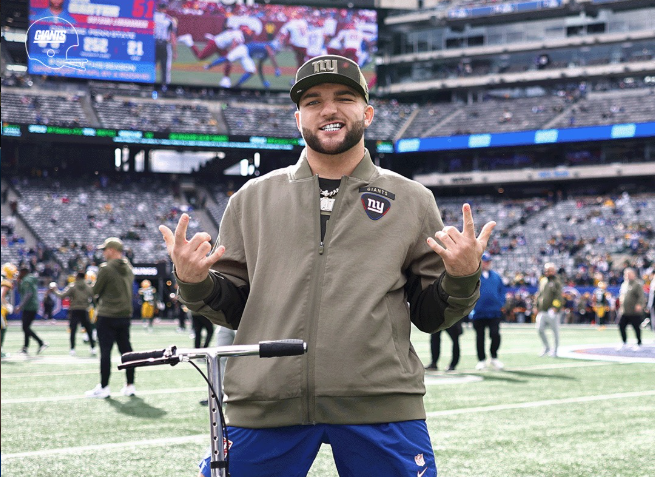
In March, Cam Skattebo appeared on The Rich Eisen Show and was asked how his recovery was going. His answer was the most honest thing any NFL player has said about coming back from a serious injury in recent memory.
“I can get away from like a baby hippo, maybe,” he said. “That’s about it. Just kind of striding out, not exploding yet.”
That was two months ago. On Monday night at the Giants’ Town Hall event at the Beacon Theatre in New York, the same Cam Skattebo stood on stage in front of the fanbase that has been waiting for him since October and told them something considerably more ambitious.
“I’m feeling good,” he said. “I’ll be ready to go Week 1.”
Week 1 for the New York Giants is September 13, 2026, a home opener against the Dallas Cowboys. That is less than four months from now.
The injury that kept Skattebo off the field for the final nine games of his rookie season was not a hamstring strain or a high ankle sprain.
It was one of the most gruesome injuries recorded in the NFL last season, and understanding exactly what happened to his body on October 26, 2025 is the only way to properly weigh what he said on Monday.
What October 26 Actually Did to His Body
The play happened in the second quarter of the Giants’ 38-20 loss to the Philadelphia Eagles at Lincoln Financial Field. Eagles linebacker Zack Baun brought Skattebo down with a hip-drop tackle, a technique the NFL has spent considerable energy trying to legislate out of the game because of the specific and severe damage it tends to cause. In Skattebo’s case, the damage was extensive.
The official injury list from that single play: a dislocated right ankle, a fractured fibula, a ruptured deltoid ligament, and an open tibia fracture.
Four separate structural failures in one moment. He was carted off the field and taken directly to the University of Pennsylvania Hospital Presbyterian campus, where surgery was performed that same night. NFL Network’s Ian Rapoport confirmed the full extent of the injuries the following day.
The surgery was successful. Skattebo posted a message from his hospital bed that evening thanking the medical staff and saying he felt loved and supported.
He was placed on injured reserve the next day and did not play another snap in 2025.
Rapoport’s recovery projection at the time was six months, with the optimistic reading being that Skattebo would be back for OTAs in the spring.
At six months from the injury date, that lands in late April 2026, which aligns with where his recovery appears to be now.
The comparison that came up repeatedly at the time was Dak Prescott’s 2020 compound fracture and ankle dislocation, an injury of similar severity that Prescott eventually recovered from fully and returned to be one of the better quarterbacks in the league.
The reference point was offered as reassurance. The healing arc for that category of injury, when surgery goes well and the athlete is young and in elite physical condition, is severe but survivable.
Skattebo was 23 years old when it happened, drafted in the fourth round out of Arizona State. Before the injury he had become one of the more compelling stories in the league.
He was leading all NFL rookies in yards from scrimmage at the time of his injury, had scored seven touchdowns in seven games, and had developed the kind of instant chemistry with fellow rookie quarterback Jaxson Dart that offensive coordinators spend years trying to manufacture.
The two players had lived together during their first season, a detail that says something about how tight that connection became from the moment they both arrived in New York.
Skattebo was a fourth-round pick, undersized at 5 feet 9 inches and 220 pounds, running with the kind of controlled aggression that makes defenders in open space uncomfortable. Giants fans fell for him immediately.
Then the hip-drop tackle happened and he spent the winter relearning how to stride.
Read More: J.J. Watt’s Texans Reaction Video Revives Brian Cushing Brother-in-Law and Wife Connection
What the Giants Are Betting On in 2026
The clearest indication of how the Giants organisation views Skattebo’s recovery is what they did not do during the 2026 NFL Draft. They did not select a single running back.
On a roster where the featured back spent the entire offseason rehabbing a four-pronged ankle injury and could not yet explode in any direction as recently as March, the front office looked at the available draft class and decided the room they already had was sufficient.
That is either an act of genuine confidence in Skattebo’s recovery or an organisational miscalculation that will become obvious by September. There is not much middle ground.
New head coach John Harbaugh, who replaced the previous staff this offseason after 18 seasons leading the Baltimore Ravens, has built his entire identity around a physical, ground-based offensive philosophy.
His Ravens teams ran the ball with conviction in a way that made opposing defenses structurally unsound. He wants the 2026 Giants to operate from the same foundation, and the offseason moves reflect that.
New York signed Pat Ricard, the All-Pro fullback who spent the last two seasons leading the way for Derrick Henry in Baltimore, on a two-year deal.
Ricard’s presence in the backfield is not subtle maneuvering. It is a public declaration that this team plans to make defenses account for a running back first and build everything else out from there.
For that plan to work, Skattebo needs to be healthy and without limitations. A running back who is protecting an ankle, hesitating in traffic, or mentally flinching at contact is not the same player who was outrunning linebackers in open space and leading rookies in scrimmage yards.
Skattebo acknowledged this himself on Monday, in terms that were more honest than most athletes tend to be about the psychological dimension of injury recovery.
“The mental battle has been the hardest part,” he said. “Making sure that I trust it fully.”
That admission matters more than any physical progress report. The physical rehabilitation from a dislocated ankle with a fractured fibula and ruptured ligament, when managed well, follows a reasonably predictable path.
What does not follow a predictable path is the moment a running back takes his first real hit of the preseason on that exact ankle and has to decide in real time whether he still trusts it.
That split second of hesitation, which cannot be rehabbed away in any training facility, is the variable nobody can account for right now.
Skattebo was also characteristically unsparing when asked to assess his own rookie season, which by any objective measure was an impressive debut for a fourth-round pick.
“I do not consider that successful for me,” he said. “I had 400 yards on 100 carries.”
The standard he is holding himself to is the thing worth noting there. Not relief at having produced at all as a late-round rookie on a rebuilding team.
Not satisfaction at earning the crowd’s affection and his quarterback’s trust. A quiet dissatisfaction with the output and an obvious hunger to show what he can do over a full season.
The Giants open against Dallas on September 13. Mandatory OTAs began this week. Training camp opens in July.
The timeline is tight and the injury was serious and as recently as two months ago Skattebo was telling a national television audience that his top speed was comparable to an infant hippopotamus.
He is saying something different now and the organisation is betting that he is right.
Whether the baby hippo has become something faster than that by the time the Cowboys come to town in September is the most important question the Giants have to answer before the season begins.
