

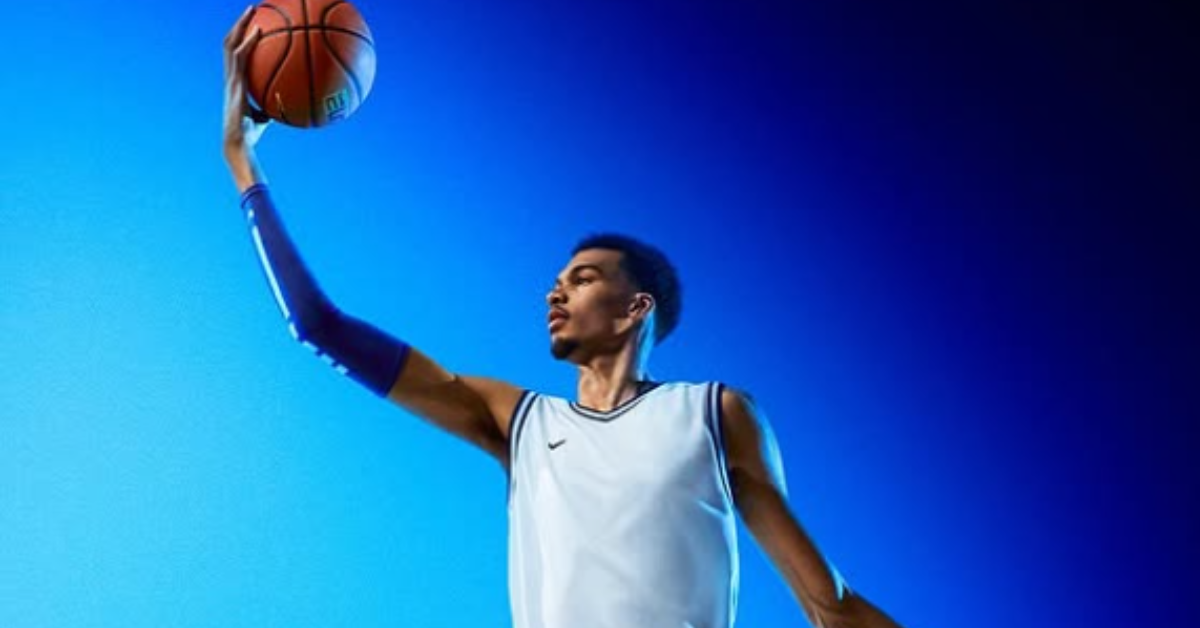
Victor Wembanyama’s size has always looked almost impossible on a basketball court, but the family behind it makes the picture much clearer.
The San Antonio Spurs star stands 7-foot-4, and he grew up in a home where height, movement and high-level sport were already part of daily life.
His father Félix Wembanyama is around 6-foot-6, his mother Élodie de Fautereau is around 6-foot-3, and both brought elite athletic backgrounds into the family long before Victor became one of the NBA’s most watched young stars.
That family background matters because Victor was never just a very tall kid learning basketball from scratch.
Félix came from track and field, competing in jumping events, while Élodie played basketball and later coached the game in France. Victor did not simply inherit height from them.
He also inherited a sporting environment built around body control, timing, discipline and technical work. That is a big reason his game developed with so much fluidity instead of becoming limited to the paint.
The physical numbers alone already tell part of the story. Victor’s 7-foot-4 frame puts him well above even his tall parents, which helps explain why he looks different even among professional centers.
Still, the jump does not feel random once the family heights are placed side by side. A father near 6-foot-6 and a mother near 6-foot-3 create a rare base to begin with, and Victor pushed that profile into another category entirely.
What makes the story stronger is that the Wembanyama family did not revolve around height alone. Félix’s track-and-field background gave the family a connection to movement, jumping and coordination.
Élodie’s basketball life gave the family direct access to the sport Victor would eventually make his own.
By the time he was building toward the NBA, he was not learning in an ordinary setting. He was growing inside a household where elite sport already felt normal.
That influence shows up clearly in the way Victor plays. He does not move like a traditional player with his size. He handles the ball comfortably, changes direction with less stiffness than most big men and covers ground defensively with unusual ease.
The athletic mix from home helps explain that. Félix taught his children how to run properly, while Élodie helped shape the basketball side of their development. That balance between movement and skill can still be seen in Victor’s game now.
His family’s athletic identity extends beyond his parents too. Victor grew up with older sister Eve and younger brother Oscar in a home where sport became a shared language.
Eve has gone on to play basketball professionally, while Oscar has also developed as an athlete.
That wider family picture makes Victor’s rise feel less like a once-in-a-generation accident and more like the most dramatic outcome from a house already full of tall, gifted competitors.
There is also a deeper basketball thread on his mother’s side. Victor’s maternal grandfather, Michel de Fautereau, played professional basketball, and that adds another layer to the family story.
So when Victor’s size and feel for the game are discussed together, it is not just a case of one unusually tall player appearing out of nowhere. There is a real line of sport, height and basketball knowledge running through the family.
Victor’s rise has been built on much more than measurements, of course. He became the first pick in the 2023 NBA Draft, won Rookie of the Year in 2024 and quickly established himself as one of the league’s most unique defensive forces.
But the foundation for all of that was formed much earlier, in a home where athletic excellence was already familiar and where his size could be developed rather than simply admired.
That is why the question around Victor Wembanyama parents height leads to a bigger answer. Yes, the numbers stand out.
A 7-foot-4 son with a 6-foot-6 father and a 6-foot-3 mother is rare by any standard. But the more important part is what came with that size.
Victor grew up with a father who understood explosive movement, a mother who understood basketball detail, and a family environment that treated elite sport as something to be worked on, not just talked about.
