

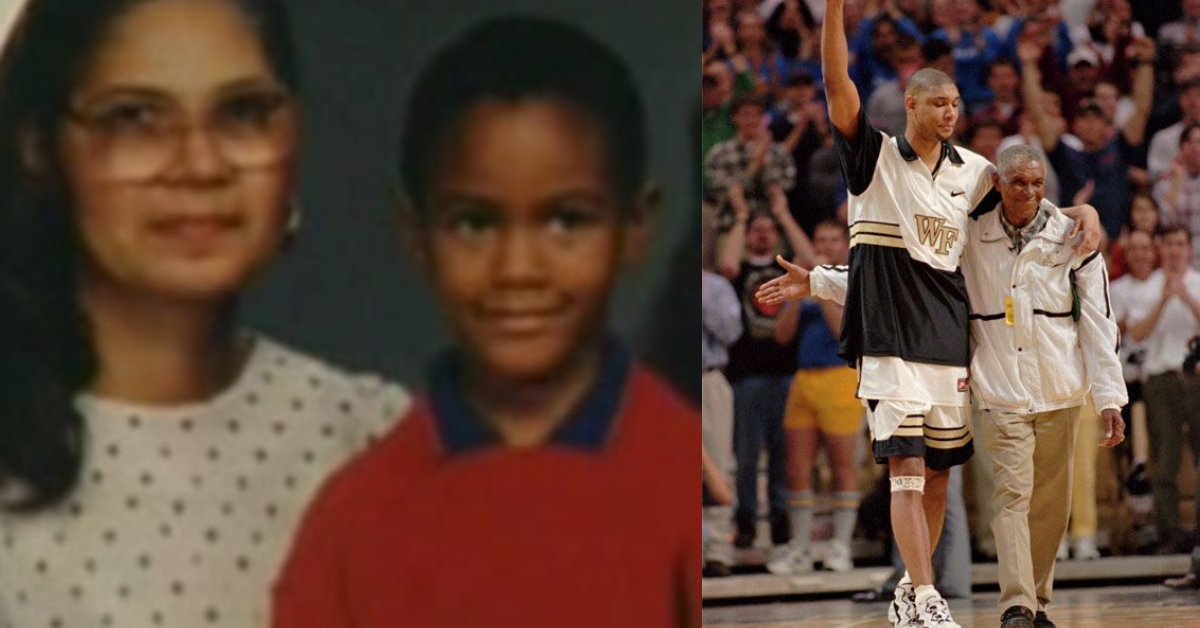
Tim Duncan’s basketball career is usually told through championships, bank shots and quiet greatness, but the story started long before San Antonio.
It started in St. Croix, where Duncan grew up with parents who gave him structure, ambition and the kind of steady values that later defined everything about the way he played.
His mother, Ione Duncan, worked as a midwife. His father, William Duncan, worked as a mason.
Together they raised a family built around discipline, effort and sport, and that foundation stayed with Duncan long after he became one of the greatest power forwards in NBA history.
Before basketball took over his life, Duncan’s dream was the pool. He grew up in a family that already knew competitive swimming well, and he wanted to follow the same path as his sister Tricia, who competed for the U.S. Virgin Islands at the 1988 Olympics.
For a time, that looked like the future. Duncan became a strong young swimmer in St. Croix and aimed high, but life changed quickly.
In 1989, Hurricane Hugo destroyed the island’s only Olympic-size pool. Around the same period, his mother became seriously ill with breast cancer. The swimming dream that once felt clear suddenly gave way to something much heavier.
The deepest break came on April 24, 1990, when Ione Duncan died of breast cancer, one day before Tim’s 14th birthday.
That loss became one of the defining moments of his life. Before she died, she made Duncan and his sisters promise that they would finish college.
It was not a small request and it did not fade with time. Even after Duncan turned into an elite college star and one of the most obvious future NBA picks in the country, he carried that promise with him.
That promise helps explain one of the most unusual decisions of Duncan’s career. He was good enough to leave Wake Forest early, and in another life he probably would have.
Instead, he stayed all four years, earned his degree in social psychology in 1997 and entered the NBA only after finishing what his mother had asked of him.
In a basketball world that often rewards speed and early exits, Duncan chose patience. It fit him, and it fit the values that had shaped him at home.
William Duncan’s role mattered just as much, even if it was quieter in the public story. Duncan’s father helped hold the family together after Ione’s passing, and the balance between grief and steadiness became part of the atmosphere Tim grew up in.
The family’s values were simple and demanding. Work mattered. Character mattered. Improvement mattered.
Duncan later carried a family motto from his mother into adult life, built around pushing good into better and better into best. That outlook showed up everywhere in his career, not through speeches or self-promotion, but through consistency.
Read More: Victor Wembanyama Parents Height Shows Where the Spurs Star’s Rare Size Comes From
A Family Story Behind a Quiet Superstar
What makes Tim Duncan’s parents story powerful is not only the tragedy. It is the way that pain and discipline became part of the player people later watched in San Antonio.
Duncan never built his image around noise. He did not chase attention, and he rarely tried to sell himself as larger than the game.
The steadiness that became his trademark looked a lot like the life lessons he got at home.
Recent coverage around The Boy From St. Croix documentary has pushed that side of Duncan back into focus, showing how deeply family, island life and personal loss shaped the man behind the Hall of Fame résumé.
By the time Duncan reached the NBA as the No. 1 pick in the 1997 draft, the emotional part of the story was already years old, but it was still driving major decisions.
He brought that same grounded approach into the league and stayed with one franchise for his entire career.
Five championships later, the connection between the player and the upbringing looked even clearer.
Duncan’s game was never built around flash. It was built around reliability, discipline and a refusal to drift from what mattered.
His career eventually made the U.S. Virgin Islands proud far beyond basketball. But the roots of that story sit with Ione and William Duncan.
One gave him a promise that changed the direction of his life. The other helped carry the family through loss and keep the structure around him intact.
Together they shaped the emotional spine of a career that often looked calm from the outside, even though it was built on grief, responsibility and a deep sense of purpose.
That is why Tim Duncan’s parents remain such a meaningful part of his story. His greatness did not begin with an NBA debut or a college breakthrough.
It began in St. Croix, in a home where expectations were real, love was steady and a promise to his mother became one of the most important decisions of his life.
